The real difference between introverts and extroverts
When I tell people I’m writing about introversion, they always say, “I’m an introvert too, but I have extroverted tendencies, and people don’t believe I’m an introvert.”
We use behaviors to define introversion, but that’s not what it is.
There are a lot of prejudices and also limiting beliefs about those two personality traits. These are the stereotypes we usually use, but they’re wrong.
- going to networking events, talking with a lot of people: extrovert
- being quiet: introvert
- charismatically presenting: extrovert
- working alone and avoiding meetings: introvert
- seeking adventure and excitement: extrovert
- not partying: introvert
My mission is to bust the prejudices and limitations about introversion and tell everyone what it really means to be an introvert based on research.
The points above are behaviors everyone can do and excel at and have nothing to do with introversion vs. extroversion. We misuse the words to put people in drawers.
Introverts’ and extroverts’ brains are built differently.
The things I’ll be talking about are based on the research from the books “Quiet” by Susan Cain and “The Introvert Advantage” by Marti Olsen Laney, Psy.D.
What does being an introvert mean?
This comes down to differences in stimulation sensitivity and how the nervous system processes input. There are 3 main differences:
- how you refuel
- how you respond to stimulation
- how you approach knowledge and experiences
Introverts are stimulated faster and more easily because they process the world more intensely and more slowly. We are more observant, and all of that needs to be processed.
Were you ever in a group of people trying to talk and socialize, but your brain was just empty? That’s stimulation overload. I also like to call it brain freeze.
The environment or the people might be too loud, they are changing the topics fast, or you don’t have anything in common with them.
That moment when your mind goes blank isn’t a social failure. It’s stimulation overload. But with practice, networking is a skill I learned, and you can learn too.
We need more time to think and process the environment, the new people, the topics, and what answers might work. And because of the stimulation overload from the outside world, our energy drains faster.
We need time alone to recharge. Less stimulation and more time to process (and overthink everything).
It’s like a battery that needs to be recharged. Extroverts recharge through external stimulation, such as people or loud environments. Introverts recharge through being alone in a quiet space.
The third difference is about breadth and depth. Extroverts want to be everywhere and talk to everyone. They are generalists. They know many people and say they’re all friends, even though they don’t know much about them.
Introverts, however, prefer depth. They love having deep talks with friends. They love focusing on one problem and fixing it.
This depth is why many scientists, researchers, and creators produce breakthroughs through sustained focus. Albert Einstein is one famous example.
Introverts and extroverts need different work environments to thrive.
- Introverts: quietness to focus and get it done
- Extroverts: buzzing open-plan office or coffee shop
It’s about different responses to stimulation, and that affects their energy levels.
I worked in an open-plan office, and I always needed to be aware of what was going on around me because my boss could call me anytime. On one ear, I have some podcast or music to block out some noise so I can focus, but I’m not 100% productive in this environment.
For extroverts, working from home alone is not stimulating enough to be productive. They need someone or noise.
What does this mean for the points I made at the beginning of the newsletter?
Introversion IS NOT about behavior but about how the brain works.
Behaviors can be practiced.
Introverts can learn:
- to talk with people confidently (with people we trust, we behave “like extroverts”)
- to present charismatically and confidently
- to lead a big team of employees and talk in meetings with impact
- to love adventures and excitement
But it always comes back to finding the balance and recharging our battery.
And just like that, extroverts can also learn:
- to listen
- to observe
- to focus and work alone on a project
- to be independent
- to enjoy quietness
But they need people and noise to keep their energy high.
Some might say now, “I’m an introvert, but in some contexts I can confidently talk a lot and feel like an extrovert.” Everyone has those contextual personality shifts, but introversion always comes back to how you gain your energy and not about how you behave.
It’s a spectrum
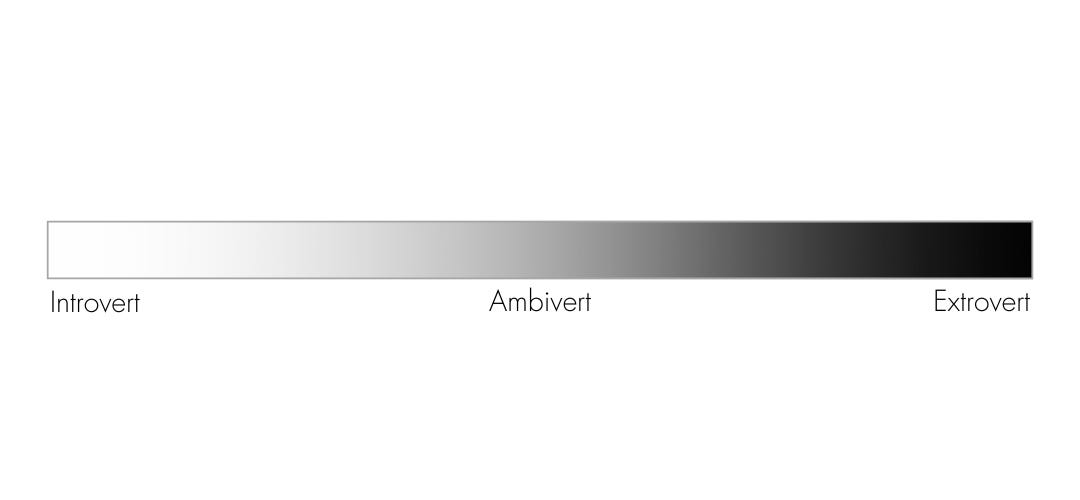
Nobody is 100% introverted or extroverted. Everyone is somewhere on the spectrum in between, just like the Gaussian distribution.
As we age, everyone moves more into the middle because we find the balance of quietness and confidence to talk more. And I agree. We grow, and we expand our comfort zones, and that includes becoming more ambivert.
Aging also comes with gaining wisdom and confidence and letting go of people-pleasing. It makes one person more comfortable being themselves and speaking their mind. Less overthinking, which is what introverts tend to do a lot.
This doesn’t mean your nervous system changes. It means your skills and self-trust expand.
I’m 31 now, and I can already feel the pull towards ambiversion as I’m growing, working on my business, and caring less about what other people think.
People-pleasing limited my actions and words a lot. At first, I let go of my shyness through years of talking with strangers and being the leader of an NGO. And now I care less about what other people think with every year I’m getting older (and every post I’m publishing on Instagram).
Introversion isn’t something limiting
Growing up, I saw my quietness as something bad. I asked myself a lot, “What’s wrong with me?” Because all I saw were loud, confident peers and grown-ups.
And that quietness didn’t fit in well in the school system made for extroverts, where you had to give presentations and show your interest and knowledge by saying something in front of the whole class.
It took me years to get over my shyness and accept my quietness as something special and positive because of the prejudices and beliefs society ingrained in me growing up.
30 to 50% of the world population is introverted. We’re not a minority.
And there are also cultures more introvert-based, like parts of Asia or Northern Europe.
You are not alone. Introversion isn’t something negative.
It’s just the beliefs we learned growing up that shape how we see the term and us.
This personality spectrum is not about confidence, leadership, or success. All 3 of them can be learned, practiced, and earned. It’s about how your nervous system recharges and how your brain processes the world.
I don’t like to put labels on you or me, because they can limit us. But I want you to understand your current status on the introvert-extrovert spectrum so you can choose strategies, systems, tools, environments, and habits based on what you need, not what other people are doing.
Here’s a quiz to figure out where you are on the spectrum.
The Quiz
Check the scoring and interpretation below when you’re finished (you don’t have to click submit).
Scoring
- More than 5x A: You’re an Introvert.
- More than 5x B: You’re an Ambivert.
- More than 5x C: You’re an Extrovert.
Interpretation
Introvert
Your brain is a deep thinker. You gain energy from quiet time and processing internally. You’re not shy or antisocial but selective with your energy, which is good in today’s world of many loud, attention-seeking people.
Your power comes from focus, depth, and reflection.
But don’t limit yourself to this label. You can have fun at networking events and meet new people, too. Be curious and open!
Ambivert
You’re in the middle of the spectrum between introversion and extroversion. Depending on the answer to questions 1 and 2, you should check how you gain energy.
You can thrive in quiet and social settings, but only with awareness and balance.
Your strength is adaptability, and you need to find a balance that works for you.
Extrovert
Your brain is a fast thinker. You gain energy from interaction and external stimulation. You process by doing and speaking. You need the buzzing world and people around you to be motivated and energized.
Your power comes from momentum and connection. But be aware of who you surround yourself with so as not to get controlled by the outside world. It’s still your life, dreams, and goals.
Take some time to understand yourself!
No type is better than the other, but some cultures prefer one over the other. I don’t want you to get limited by society or those labels.
Each type can be happy and successful in their own way.
Don’t judge or limit, but embrace your strengths and find your own unique way!
If you’re not done thinking yet…
Many introverted people tell me this is where they pause.
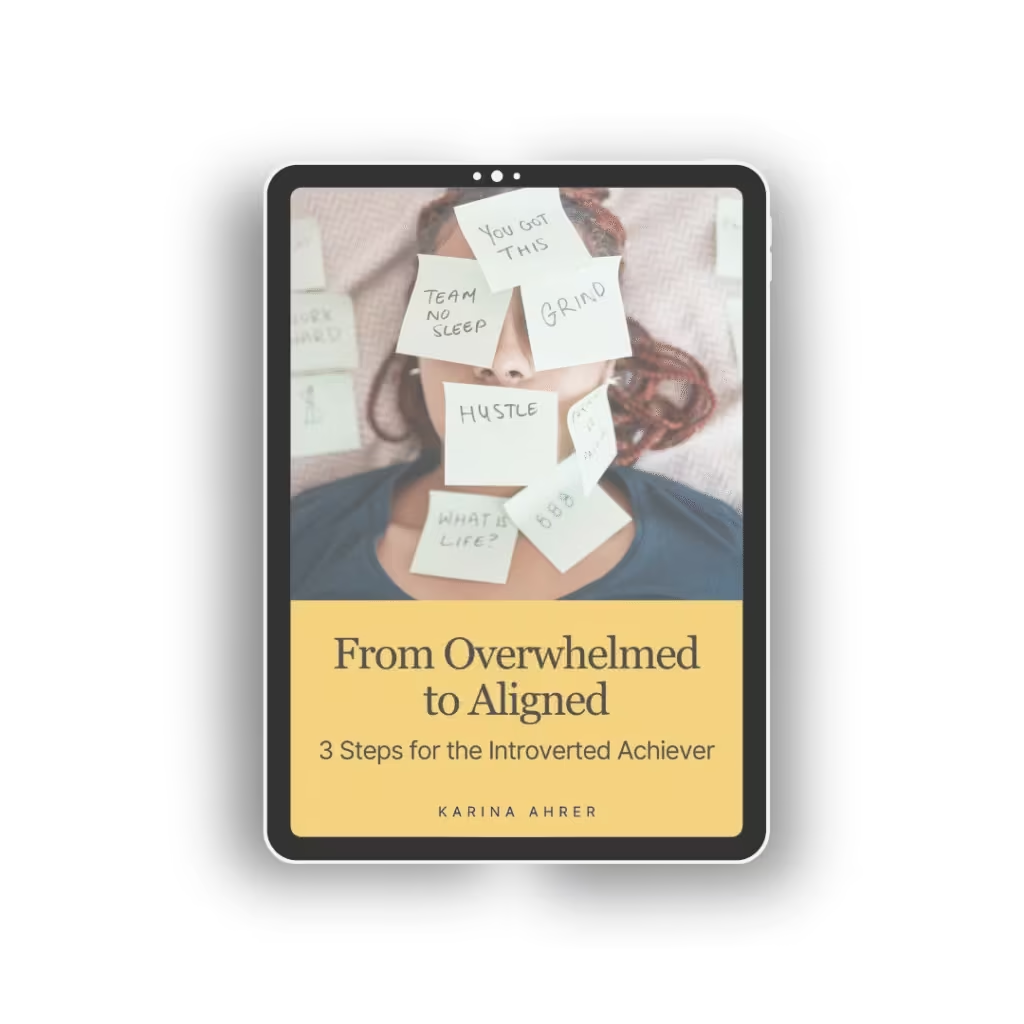
This short 0€ guide helps you move from overwhelm to alignment gently.
Follow me on your favorite social media here: